
There was such a "tacit interaction" between the two system giants: Google was revealed to be developing a function for the Android system, which is exactly the same as Apple's "NameDrop". This once again proves that it is normal for mobile ecosystems to learn from each other. For ordinary users, the real key is what substantial conveniences this competition can bring.
Basic form and operation of functions
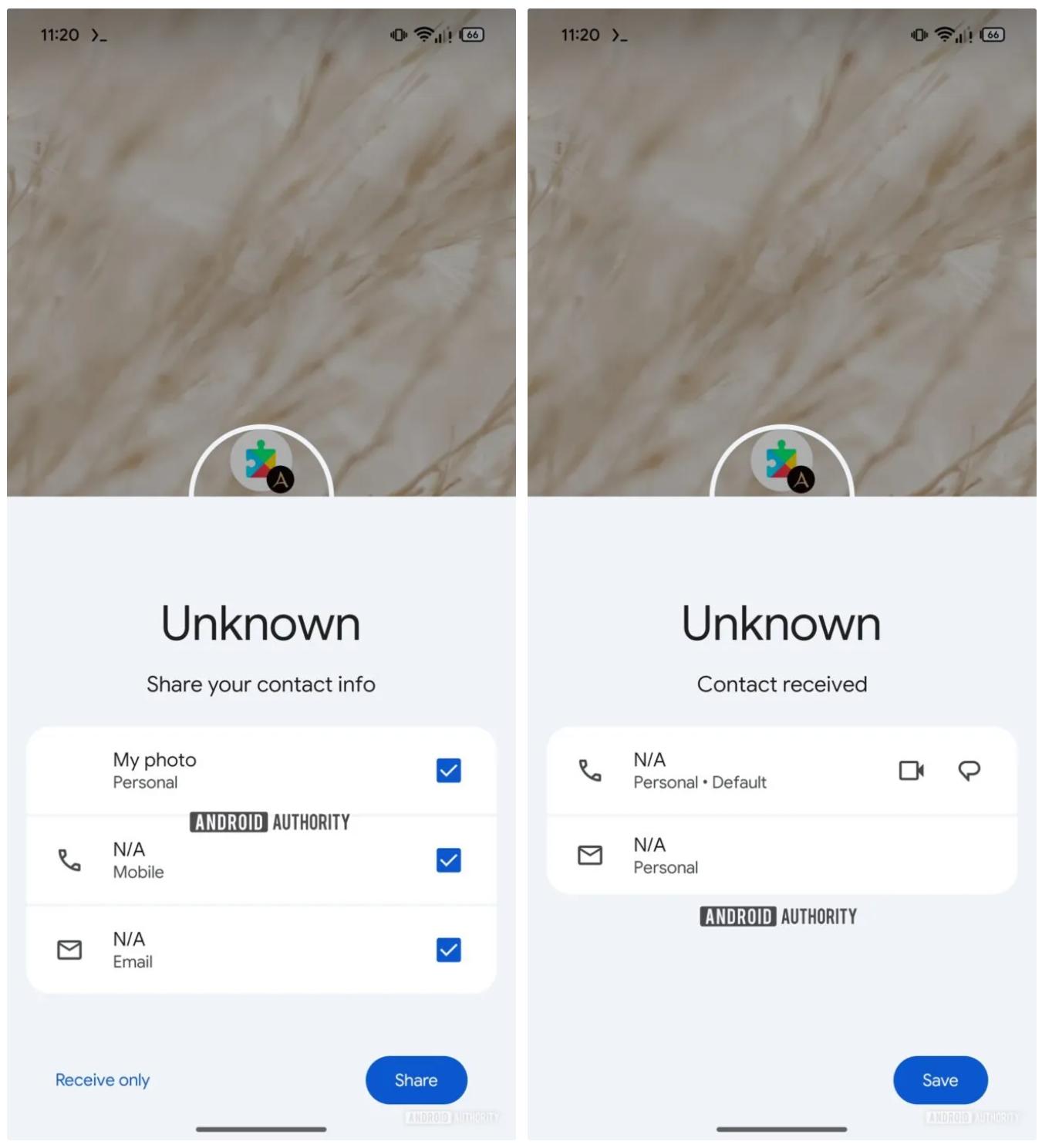
The feature, which is internally codenamed "Gesture Swap," aims to simplify the process of exchanging contact information between Android users. According to the leaked interface screenshots, users can trigger this function with a simple gesture such as bringing two mobile phones close to each other, and then a sharing options page will pop up on the screen.
On this page, users can choose the specific information they want to share. The items that can be checked include personal avatar photos, commonly used mobile phone numbers, and email addresses. This design gives complete control to the user, preventing unnecessary privacy leakage due to misuse.
Key "Receive Only" Privacy Options
One noteworthy highlight of this feature is that it provides a "receive-only" mode. When the user clicks this button, the phone will enter a "silent" state, in which no personal information will be sent out. In this specific mode, the user can one-way receive contact information actively shared by the other party.
This gives great flexibility to many social scenarios. For example, in exhibitions or conferences, when you want to obtain information about speakers or exhibitors, but do not want to expose your contact information, this mode is extremely practical. It actually partially transfers the initiative of “scanning the QR code to add friends” to the recipient.
Information receiving and integration process
When the information exchange is completed, the recipient's mobile phone will jump to an interface specifically designed for integration. All the information shared by the other party, such as avatar, phone number and email address, will be clearly displayed on this preview page. The received avatar will be automatically set as the new contact's photo.
Click the "Save" button on the interface, and the system will automatically create a new contact entry for the user, and fill all the received information into the matching fields. This eliminates the complicated steps of manual input, verification, and manual saving, and reduces an operation that originally took several minutes to a single click.
Possible paths for technical implementation
From a technical point of view, the string "ndef" that appears in the code strongly implies that this function is achieved based on NFC technology. NFC is near field communication. Its characteristic is that the device must be at an extremely close distance, usually within a few centimeters, to trigger a connection, and the security is relatively high.

Considering that the shared information may include files with a relatively small amount of data such as photos, the efficiency of transmission using NFC alone may be relatively low. Therefore, a more reasonable solution is to use NFC to achieve secure device pairing and "handshake", and then automatically switch to Bluetooth or Wi-Fi Direct for high-speed data transmission. There is a precedent for such a hybrid technology solution in the Android ecosystem.
Similarities and Differences with Apple NameDrop
When iOS 17 was launched, Apple's NameDrop feature came with it, which allows iPhone users to exchange contact information by bringing the tops closer. The features currently being developed by Google are very similar to it in terms of core experience, and are all based on "touch and send" based on proximity sensing.
The main differences exist between the two, most likely in detailed interactions and ecological integration. For example, it is this Android feature that currently exposes an explicit "receive-only" mode, and NameDrop is more focused on two-way peer-to-peer exchange. In addition, the deep integration of Google's functions with its own address book and messaging applications will become the key to observing the integrity of its experience.
Functional prospects and user impact
Currently, this feature is still in the early stages of development, and it is still uncertain whether it will be officially released with a major Android version update. Its official name is still not determined. "Gesture exchange" or "Contact exchange" are just internal code names.
If this feature can be released, it will directly improve the efficiency of offline social interactions between Android devices, and may even include devices from other brands. This is not just a copy of functions, but also a complement to the ecological experience, prompting the entire industry to continue to evolve in terms of standards for seamless cross-device connectivity.
When exchanging contact information with a new acquaintance, which method do you usually prefer to use? Scan the QR code, type manually, or look forward to the "touch and touch" experience? You are welcome to share your opinions in the comment area. If you find this kind of comparative analysis helpful, please like it and support it.
