The ACCA June exam season has entered the countdown period. Among the many FM candidates, up to 90% of them are in trouble due to problems with the review order, resulting in the loss of scores that should have been obtained. If you master the appropriate sprint sequence and the required knowledge points, then in the last two months, you will be able to improve your scores efficiently and pass the exam easily.
The best order to review before the exam
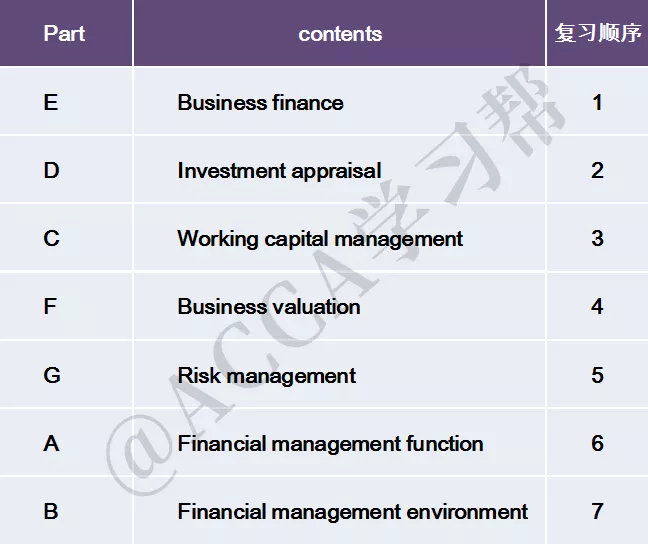
The seven parts of FM are not an MBTI career test that you can just flip through the book casually. The correct review order can allow you to get twice the result with half the effort in the learning process. It is also recommended that you start reviewing Part D investment decision-making first, because this specific part covers NPV, a 25-point question that must be tested every year, and it accounts for the largest proportion of the total score in the entire exam. Once you successfully master the content of this specific part, then you are equivalent to firmly occupying half of the entire exam.
Following the review of Part E financing decisions, this part is closely related to investment decisions. Only after understanding the cost of capital can we better grasp the financing methods. Then comes Part B, Financial Management and Environment. This part has a strong conceptual nature and is suitable for understanding and memorizing after having a certain foundation. Finally, review Part C working capital market management and Part F risk management again.

Part AFinancial Management Fundamentals
This part of the content related to the objectives, roles and macroeconomic environment of financial management belongs to the entry-level category and is mainly introduced. In the exam in March 2023, some candidates reported that the frequency of multiple-choice questions in this part was relatively high. Particularly, it was necessary to focus on mastering the questions about stakeholder goal conflicts, and so on.
When reviewing, be sure to distinguish between the two goals of shareholder wealth maximization and profit maximization to understand the relationship between shareholders and managers in agency theory. It is recommended to spend 3 days browsing the knowledge points and practice with multiple-choice questions from the past two years to ensure that you do not lose points for basic concepts.
Part BFinancial Management and Environment
The functions of financial markets, the functions of financial institutions, and the efficient market hypothesis are the core test points here. In the exam in December 2022, an essay question involving strong-form efficient markets caused many candidates to encounter setbacks. It is important to remember that different efficient markets have different degrees of reflection of information.
This part of the content will also involve the examination of the term structure and risk structure of interest rates, and it is necessary to understand the conversion between nominal interest rates and real interest rates. It is recommended to use a mind map to organize and present the characteristics of various market types. Sufficient time of 4 days is required for comparison and memory to prevent confusion.
Part C Working Capital Management
Cash management strategies, inventory management strategies, accounts receivable management strategies, and accounts payable management strategies are particularly critical core points here. In the exam held in June 2023, relevant calculations were made for economic order quantity. However, many candidates forgot the calculation formulas of holding cost and ordering cost, thus losing points for no reason.
You need to learn to use the Baumol model and the Miller-Orr model to calculate optimal cash holdings, and you also need to master the factor analysis of accounts receivable. This part of the calculation requires a lot of calculations. It is recommended to spend 5 days to practice various calculation problems and engrav the formulas deeply in your mind.
Part D Investment Decision
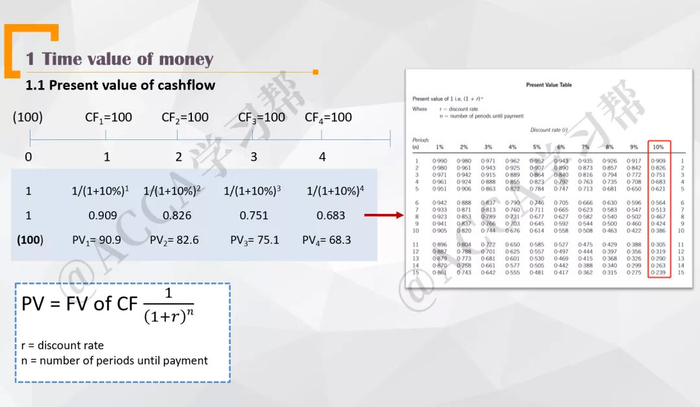
The ability to calculate NPV here is king, and every year at least one big question worth more than 15 points tests it. From 2019 to 2023, in the exams held in March, June, September and December every year, NPV-related questions have never been absent, with the exception of March 2018.
In addition to net present value, internal rate of return, investment payback period and accounting rate of return also need to be mastered. In a 2021 exam question, it is actually required to compare the advantages and disadvantages of net present value and internal rate of return. Questions like this theoretical type often appear. It is recommended to spend as long as 10 days to actually solve a complete net present value question every day, and be sure to familiarize yourself with the calculation steps.
Part E Financing Decision

The core here is the calculation of capital cost, which covers equity capital cost, debt capital cost and weighted average cost of capital. In the exam in September 2022, there was a question that required the use of the capital asset pricing model to calculate the cost of equity MBTI personality test , and it also required comparison with the dividend growth model.
The advantages and disadvantages of various financing methods and capital structure theory are also frequently tested topics. MM theory needs to distinguish between the conclusions in the presence of tax and the absence of tax. For this part, it is recommended to spend 6 days focusing on practicing the calculation of capital costs and the comparative analysis of various financing methods.
Part FRisk Management
The difficulty here lies in the management of foreign exchange risk and interest rate risk, the calculation of forward exchange rates, and the basic principles of futures and options. In the exam in March 2023, a question involving currency swaps caused many candidates to not know where to start.
This part of the content is abstract. It is recommended to understand it through examples from life. It is recommended to spend 4 days to learn the principles and calculation methods of various hedging tools, focusing on forward contracts and hedging operations in the currency market.
Part G Corporate Valuation
Different methods of business valuation, including asset-based approach, income-based approach and market-based approach are all located here. The exam in December 2022 required the use of the dividend valuation model to calculate stock prices, and many candidates ignored the calculation of growth rate.
Closely link this part with previous investment decisions and financing decisions, and use knowledge comprehensively. It is recommended that you spend three days browsing the applicable conditions and calculation formulas of various valuation methods, and practice with past questions.
15 most commonly tested knowledge points in FM
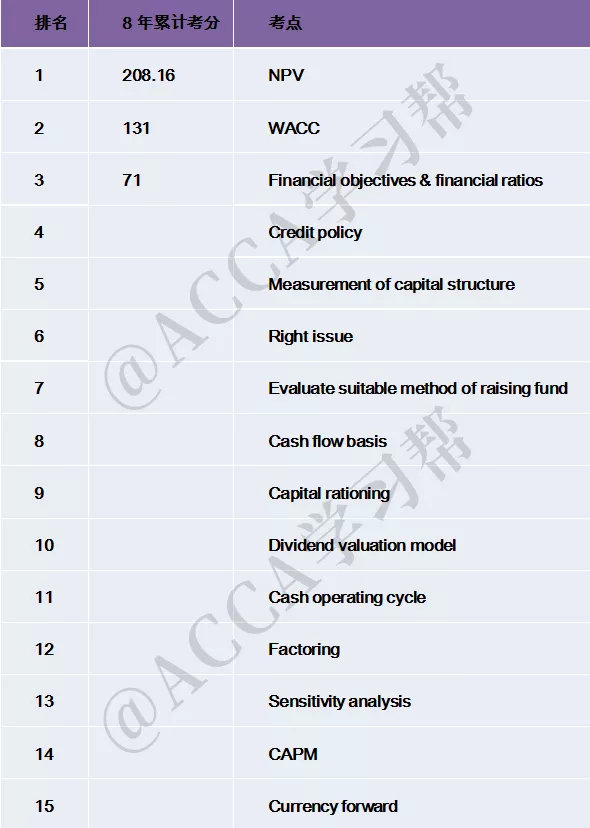
Based on statistical analysis based on global exams in the past five years, in the FM exam, the knowledge point that appears most frequently is NPV calculation, which is tested in almost every exam. Then there is the calculation of the weighted average cost of capital, which occurs at least twice a year. The third is the economic order quantity model in working capital management.
The fourth position is the capital asset pricing model, the fifth position is the investment payback period and accounting rate of return, the sixth position is the dividend policy theory, the seventh position is the forward exchange rate calculation in foreign exchange risk management, and the eighth to tenth positions are capital structure theory, MM theory and cash management model.
Revenue and accounts management is number 11, inventory management is number 12, financial statement ratio analysis is number 13, business valuation methods are number 14, and interest rate risk management is number 15, they are ranked in order. These knowledge points will appear in rotation in different topics every year. And they cover all parts of the FM exam.
NPV calculation questions that must be taken every year
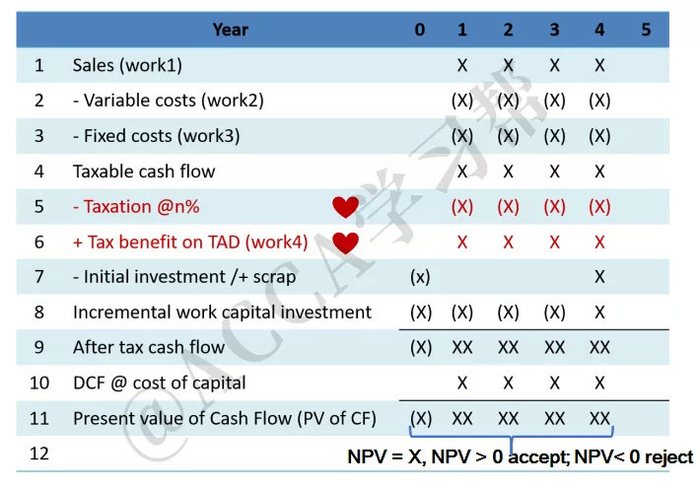
NPV calculations have been carried out since 2011. Except for the exam in March 2018, every assessment every year will present it in the form of large questions in 16personalities Chinese , with scores ranging from 9 to 17.5 points. The key point of this question is to calculate the relevant cash flow after tax, and then discount it according to the cost of capital.
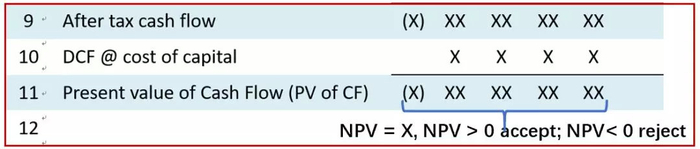
The essence of NPV calculation is to find a set of after-tax related cash flows, discount this set of data and add them up. The calculation process goes through twelve adjustments, covering many steps such as initial investment, working capital, annual cash flow, tax implications, depreciation tax shield and salvage value recovery.
When calculating NPV, be sure to distinguish between relevant cash flows and irrelevant cash flows. Only the former can be used in the calculation of NPV. Sunk costs and costs that have already been incurred are irrelevant cash flows and cannot be included. Opportunity costs are relevant cash flows and must be taken into account.
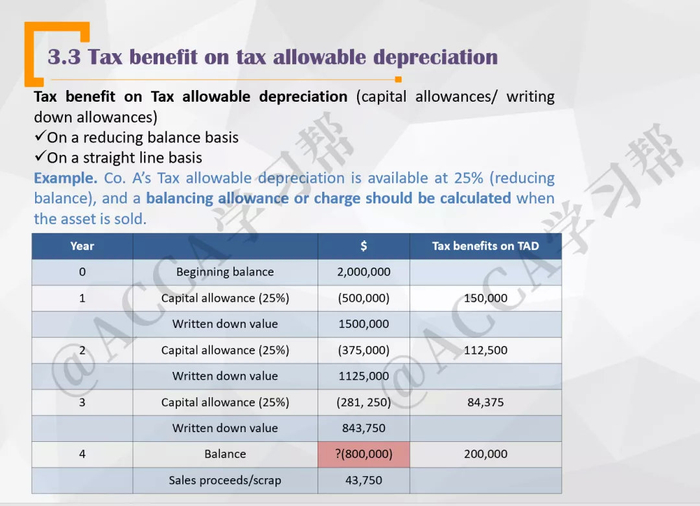
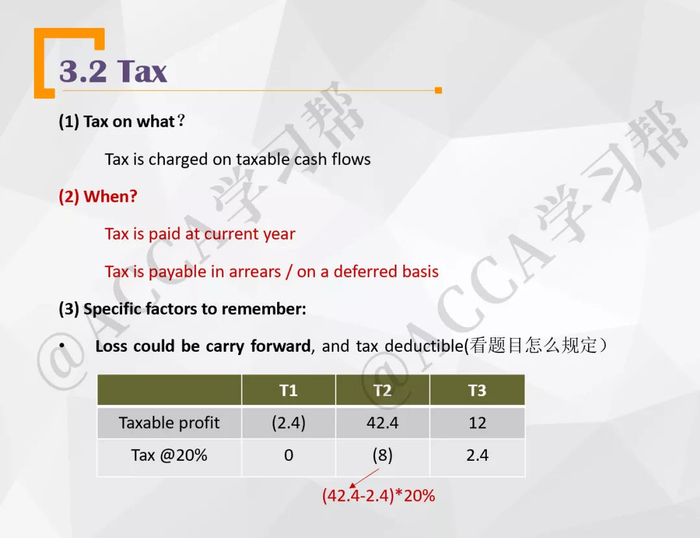
For cash flow, the impact of taxes is mainly reflected in two aspects. One is the direct implementation of tax on operating cash flow, and the other is the use of tax allowable depreciation to generate a tax shield. When calculating the depreciation tax shield, it must be clear whether to use the straight-line depreciation method or the declining balance method. This is very important.
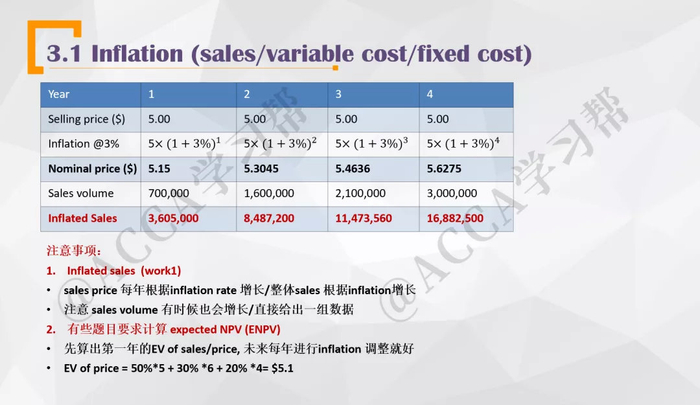
During the assessment, various capital costs will be thrown out in the question to confuse your thinking. The capital cost uses the weighted average cost of capital. For example, the cost of equity and the cost of debt may be given together, and you need to perform the weighted average calculation by yourself. If the cash flows in the question are presented in nominal terms, they must be discounted using the nominal cost of capital.
When reading the question, be sure to pay attention to three pieces of information that play an important role, one of which is the nature of the element, one is the time of occurrence, and one is the specific amount. For example, there is an expenditure of $800,000 for the purchase of machinery. The element represents the initial investment. The time point refers to the beginning of year 0, and the amount is exactly $800,000. Once this specific and accurate information has been found, half of the process of NPV calculation has been completed.
The winning formula for calculating NPV is called the unforgettable twelve. The reason is that twelve means unforgettable. There are twelve pictures for friends, twelve pictures for lovers, twelve pictures for lovers, and twelve pictures for family members. I hope students will not forget these twelve steps during the exam. If you master this test point, you will get 25 points.
Which step do you think is the most error-prone among the twelve steps of NPV calculation? You are welcome to share your relevant experience in the comment area. Like and collect this article so that more ACCA exam candidates can see this review guide.