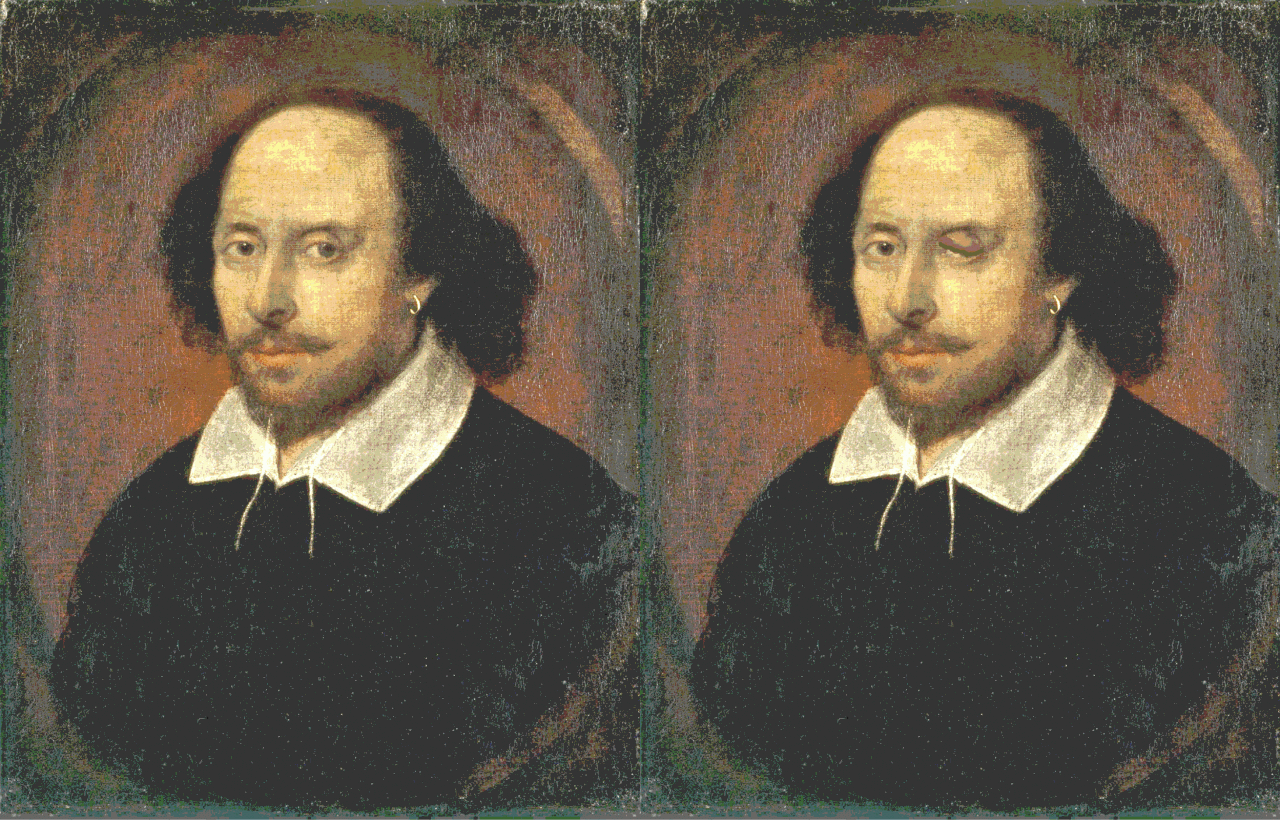
Many people may not know that the word "Photoshop" that we use for editing and designing has been officially registered in the English dictionary and has become a verb with the meaning of "modifying digital images". The situation behind this is a legendary story that originated from personal interests and ultimately achieved results in changing the global creative-related industries.
Software is born in a garage
In the 1980s, Thomas Noll, a doctoral student at the University of Michigan, wrote a small program called "Display", which was used to display digital images on a black and white display and perform simple processing. This project was entirely out of personal interest and there was no commercialization from the beginning. His brother John Knoll was working at Industrial Light and Magic at the time and was exposed to many of the needs of film special effects production. John was keenly aware of the potential of this program, so he began to work with his brothers to add image processing functions to it, and step by step transformed it from an academic toy into a tool of practical value.
From hobby to commercial product
In the summer of 1988, the Knoll brothers realized that the software they had in hand was complex and powerful enough to develop into a real commercial product. They renamed the software "Photoshop" and began looking for a company to release it. Initially, they worked with a scanner manufacturer, Barney Scanning, and sold a bundle of about 200 copies under the name "Barneyscan XP." Although this small-scale trial had limited sales, it found the first professional users of Photoshop and proved its unique value in the field of image processing.
Adobe’s visionary decision
The real turning point occurred after Adobe intervened. Adobe's art director Russell Brown witnessed the demonstration of Photoshop, expressed great appreciation for its functions, and tried his best to suggest that the company acquire its distribution license. In April 1989, Adobe and the Knoll brothers reached a licensing agreement. After nearly a year of integration and enhanced development, Adobe Photoshop 1.0 was officially released for the Mac platform on February 19, 1990. Adobe has a profound accumulation in the field of graphics and a profound accumulation in the field of fonts, which paves the way for the professionalization of Photoshop and the popularization of Photoshop.
The hardships of early development
When Photoshop was developed in the early stages, it was not completed by a large team. According to Thomas Noll's recollection, he was the only core development engineer for version 1.0, and it was not until version 2.0 that the number of people increased to two. Thomas was responsible for writing the main structure and user interface of the program, while his brother John used his experience in the film special effects industry to contribute many core image processing algorithms and filter plug-ins. This powerful team model actually achieves a high degree of unity in the design concept of the software, and the execution efficiency is optimized by directly writing the underlying assembly language for the Motorola 68000 processor.
Disclosure of code legacy
In 2020, with permission from Adobe, the Computer History Museum made Photoshop available to the public The source code of version 1.0.1. This historical archive contains 179 files, about 128,000 lines of uncommented code, and the code structure is clear. About 75% of it is Pascal language and 15% is Motorola 68000 assembly language. This move allows today's developers and enthusiasts to have a glimpse of the nascent appearance of the software giant and understand its simple and efficient design philosophy. It has also become a precious material for studying the history of software development.
Twenty-five years of continuous evolution
Since its release in 1990, Photoshop has gone through more than 15 major version updates. Its initial function was simple image correction, and later gradually expanded to include a huge system including digital photography, graphic design, illustration, web page production, and 3D and video editing. It also defined the standard of image processing, created the pop culture symbol "PS", and profoundly affected people's perception of visual authenticity. Although it faces the challenges of many emerging tools, it is still an indispensable productivity tool for millions of creative professionals around the world.
Looking back at Photoshop's journey from a garage project to becoming an industry standard, in the current highly homogeneous situation of software tools, in which field do you think the next revolutionary product that can define the entire industry like it is most likely to appear? You are welcome to share your opinions and insights in the comment area. If you think this article is helpful, please like it to support it.