
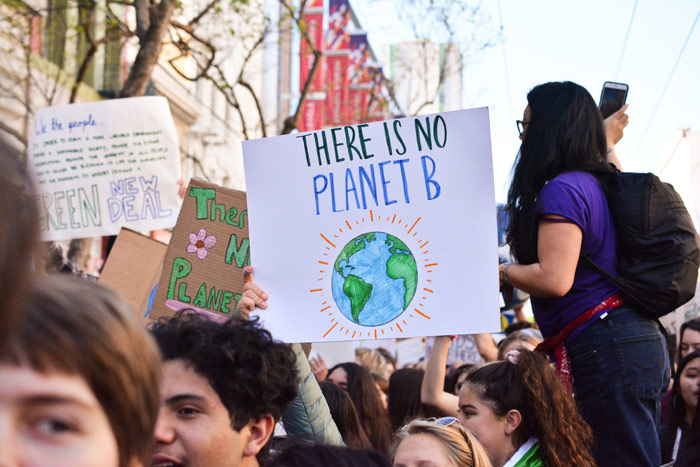
Climate emergency became Oxford Dictionary's word of the year in 2019. It beat out many popular candidates. Changes in vocabulary can accurately reflect what everyone is paying attention to in the current era. The climate emergency conveys more than just a linguistic phenomenon. It is also a global mentality change. Everyone began to use more urgent words to describe the difficulties faced by the current era.
Behind the changes in vocabulary

In 2019, the use of “climate emergency” surged by more than a hundred-fold, which is undoubtedly a strong signal. It didn’t come out of nowhere. It was the result of a combination of the global climate movement, scientific reporting, and media narratives. In 2018, the United Nations Intergovernmental Panel on Climate Change issued a special report on global warming of 1.5°C, which provided a solid basis for the word "emergency" with grim scientific facts.
The words used to express are like barometers of social consciousness. From the relatively mild "climate change" and "global warming" to the clearly pointed "climate emergency", the upgrading of vocabulary means a fundamental change in public perception and discussion framework. Such a change has caused the media and institutions involved to make adjustments to their wording. For example, the British "Guardian" updated its terminology guide in the same year, advocating the use of more urgent words.
Promoted by media and institutions
Mainstream media has played a key role in popularizing the expression “climate emergency”. In 2019, the number of reports about extreme weather, melting glaciers, and species extinctions increased globally, and these reports were often associated with "states of emergency." At this point, the media is no longer content to simply state the facts, but sets out to clearly define the nature of the problem.
At the same time, a large number of local governments have declared a "climate emergency", as have many agencies. Starting from the relevant actions taken by the British Parliament, until the Sydney City Government also took such a series of actions, such political declarations have effectively enhanced the legitimacy of the term from an official perspective and highlighted its seriousness. These actions, together with media reports, have a resonant effect, pushing the word from its original fringe status to gradually entering the scope of the mainstream discourse system, and then evolving into a part of the default framework during public discussions.
Awakening of public consciousness
2019 was also a year in which the grassroots climate movement showed a booming trend. The youth climate strike movement, represented by "Fridays for Future", spread rapidly around the world. The young activists repeatedly used the word "emergency" in the slogans they drafted and in the speeches they gave to call for immediate action. The actions they took combined abstract climate data with concrete expressions of the anxieties of a specific generation, thus giving the corresponding words a vibrant life situation.
The amplification effect of social media cannot be easily ignored. Those posts with the hashtag #ClimateEmergency can be widely disseminated on Twitter, Instagram and other platforms, thus forming a very powerful force. Ordinary netizens who make online noise participate in the co-construction of vocabulary through behaviors such as sharing, likes, and discussions, and they also participate in the process of dissemination, which ultimately promotes its rapid spread and even gradually penetrates and integrates into the overall scope of people's daily digital communication.
Resonance with other words of the year
The “climate emergency” is not a single example. In the same year, Collins Dictionary selected “climate strike” as its word of the year, while Cambridge Dictionary chose “upcycling”. These three selections made by different authoritative dictionaries, from the perspective of protest actions, from the perspective of daily practice, to the overall qualitative situation, together depict the comprehensive and detailed attention society has paid to climate issues in 2019.
Looking at the words selected by the Oxford Dictionary in the past few years, "toxic" was selected in 2018 and "youth shock" was selected in 2017. They are all potentially related to climate issues. "Toxic" can point to pollution and environmental justice, and "Youth Shock" shows the sudden influence of the younger generation on political and social issues, which precisely paved the way for the youth-led climate movement in 2019.
Translation of scientific consensus into language
The popularity of "climate emergency" is actually a reflection of the success of turning scientific consensus into public language. Scientists have been warning about the risk of tipping points in the climate system for many years. However, words such as "change" and "warming" fail to fully convey its urgency and irreversibility. However, "state of emergency" clearly conveys the core message required, that is, to break the routine and initiate emergency response.
This transformation process does not happen by accident. Many climate scientists and science popularizers consciously use stronger language to communicate with the public. They refer to the concept of "state of emergency" in public health, disaster management and other fields. The aim is to help the public understand the scale of the climate crisis and the magnitude of the response required, so that scientific warnings can be more effectively translated into public awareness.
Limitations of language and future actions
However, upgrading vocabulary itself cannot directly reduce greenhouse gas emissions. After the "state of emergency" is declared, what is more critical is the supporting, binding policies and practical actions. If the popularity of the word fails to translate into substantial changes in legislation, investment, and personal behavior, then it may also face the risk of being "hollowed out" and become a slogan without action to support it.
Thoughts are shaped by words, but it is actions that ultimately change reality. The term "climate emergency" is like a mirror, reflecting the collective sense of crisis and desire for action in the global community in 2019. Its election is a milestone that marks a complete change in the tone of the discussion, but the next chapter will be written by global governance, technological innovation, and everyone's daily choices.
If "state of emergency" changes from a vocabulary to a consensus, how should each of us re-examine our own lifestyle and the choices we make, and then contribute specific and specific strength to this action that is absolutely necessary to win? Welcome to share your personal opinions in the comment area. If this article has triggered your inner thinking, please like it and share it with more friends.