
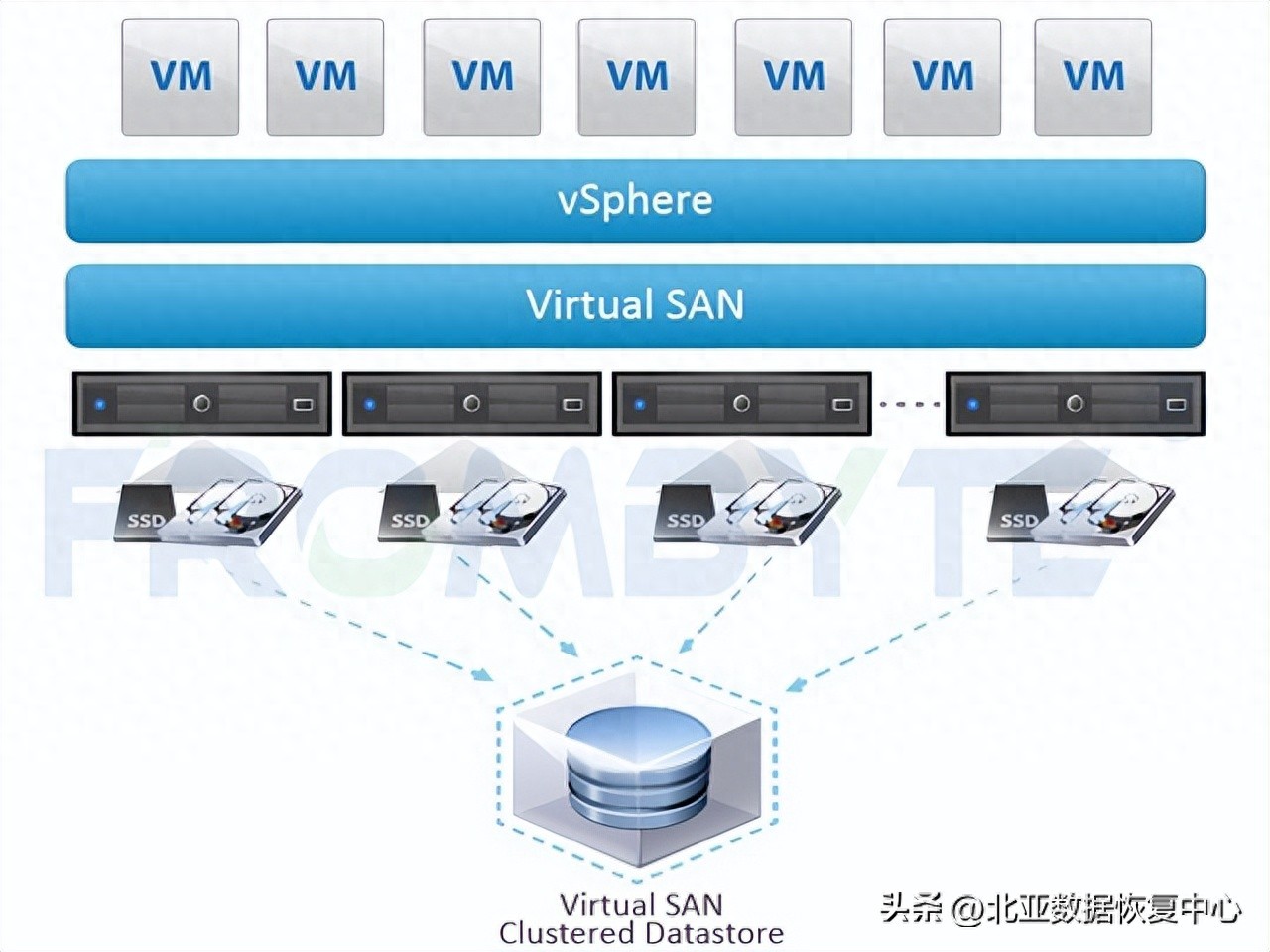
Nowadays, hyper-converged architecture is becoming more and more popular. Under this situation, the stability of VSAN storage is directly related to the continuity of core business. Once an unexpected abnormal shutdown occurs, it is very likely to cause serious virtual machine data loss. This risk is a real challenge that many IT managers must face.
VSAN storage architecture and potential risks
VSAN is a software-defined solution that can solve distributed storage problems. It relies on the local flash memory and hard disk of each host in the cluster. These are organized into disk groups as physical disks, forming a shared storage pool for the entire cluster virtual machine. The advantage of this architecture is that it integrates computing and storage resources, improves hardware utilization and deployment flexibility.

However, such a decentralized design also creates unique risks. VSAN achieves redundant operations by dividing virtual machine data into multiple components and placing them on the disks of different hosts. This shows that data integrity relies heavily on network communication between cluster nodes and real-time synchronous updates of component status. Any unexpected global interruption is very likely to destroy this exquisite balance state.
Disastrous effects of abnormal shutdown
For planned maintenance shutdowns, there is generally a standardized process, with the help of which the system can save the status in an orderly manner. However, abnormal shutdown is different from this, such as a sudden power outage in the computer room, or multiple servers experiencing abnormal power outage at the same time, which is a disaster scenario. In this scenario, the ongoing IO operation will be forcibly interrupted, the data existing in the cache will not be written to the capacity layer, and the data consistency state between each node will be broken instantly.
This situation will cause extremely serious failures in the VSAN logical architecture, specifically showing the degradation of storage objects, abnormal component status or even missing. The direct consequence is that some virtual machines cannot be started, the virtual disk files associated with them become inaccessible, and business applications that rely on these virtual machines are subsequently interrupted.
When to intervene in professional data recovery
After a failure occurs, the first principle to follow is to avoid all operations that may aggravate data damage. Never try to repair it repeatedly in the original environment, or forcibly build a storage strategy again. Improper and unreasonable related operations may overwrite the remaining data fragments, greatly reducing the possibility of professional recovery in the future.

At this time, you should contact a data recovery service provider with underlying experience in VSAN. Professional engineers will give suggestions to completely isolate the fault environment and safely remove all physical hard disks involved. These hard disks will be sent to a clean recovery working environment, and professional hardware equipment will be used to perform a complete image backup at the read-only level, thereby laying the foundation for subsequent analysis.
From physical mirroring to logical reorganization
After having sector-level images of all hard disks, the recovery work enters the core analysis stage. It is up to engineers to parse VSAN's unique object storage format. In VSAN, each virtual machine file is an object, and it is still the case that these objects are divided into multiple components, and these components are distributed on the capacity disks of different disk groups according to specific rules.
Engineers use a self-written parsing program to scan the image and extract the remaining metadata information. These metadata are like a map, recording the component ID, the ID of the object it belongs to, and the combination relationship between components. Even if the file system directory structure is in a corrupted state, as long as this metadata is not overwritten, there is hope of rebuilding the file.
Data extraction and integrity verification
Relying on the "data map" generated by the reorganization, the recovery process can accurately determine the exact location of each data component in the physical image. Immediately afterwards, engineers will extract the scattered component data blocks according to the original data distribution strategy, and perform logical splicing based on their RAID configuration information, step by step to restore the complete VMDK virtual disk file.
For situations where the cache has not been refreshed, the SSD cache disk image must be specially processed and the dirty data stored in it must be integrated into the corresponding components to ensure that the data is in the latest state. If the virtual machine has a snapshot, it is also necessary to correctly merge the snapshot file with the parent disk to ultimately create a usable, flat virtual disk file.
Final restoration of business data
The reproduced VMDK file itself is just a container, and the ultimate goal is to extract the application data in it, such as a database file. By mounting VMDK or directly analyzing its internal format, the database backup files and data files can be completely exported. Then, build the database server in a new, stable environment.
Restore the recovered database backup file, and then run the database consistency check command. When the check passes successfully and the application can be connected and accessed normally, it marks that the data recovery work is indeed successful and the continuity of the business system is restored.
For enterprises that rely on complex storage architectures such as VSAN, should formulating a comprehensive data backup and disaster recovery plan be a higher priority than hardware selection? Welcome to share your opinions and practical experiences in the comment area. If this article is helpful to you, please give it a like and support.