Every day between dozens of different software, switching modes back and forth, your working time is quietly stolen bit by bit. A survey from the authoritative and influential "Harvard Business Review" shows that employees switch applications more than 1,200 times a day on average, and the accumulated wasted time in a year reaches up to 5 complete working weeks, accounting for 9% of the total working time throughout the year. Behind this shocking number that makes people feel shocked at a glance is the nightmare of fragmentation, destruction, and disruption that countless people in the workplace are experiencing every day.
The pain of fragmented work

Turn on the computer, WeChat, email, design software, document editing, PPT production, material websites, etc., more than a dozen windows are open at the same time, which has become a standard configuration for professionals. Whenever a simple design task is completed, the designer has to switch back and forth at least 20 times between inspiration collection, sketching, material search, and software operation.
This kind of frequent switching not only interrupts the creative thinking, but also consumes extra time every time to refocus the attention. Research shows that it takes an average of 23 minutes to fully return to a state of concentration every time you switch tasks. However, switching 1,200 times a day means that you basically have not really entered into deep work.
From tool stacking to system reconstruction
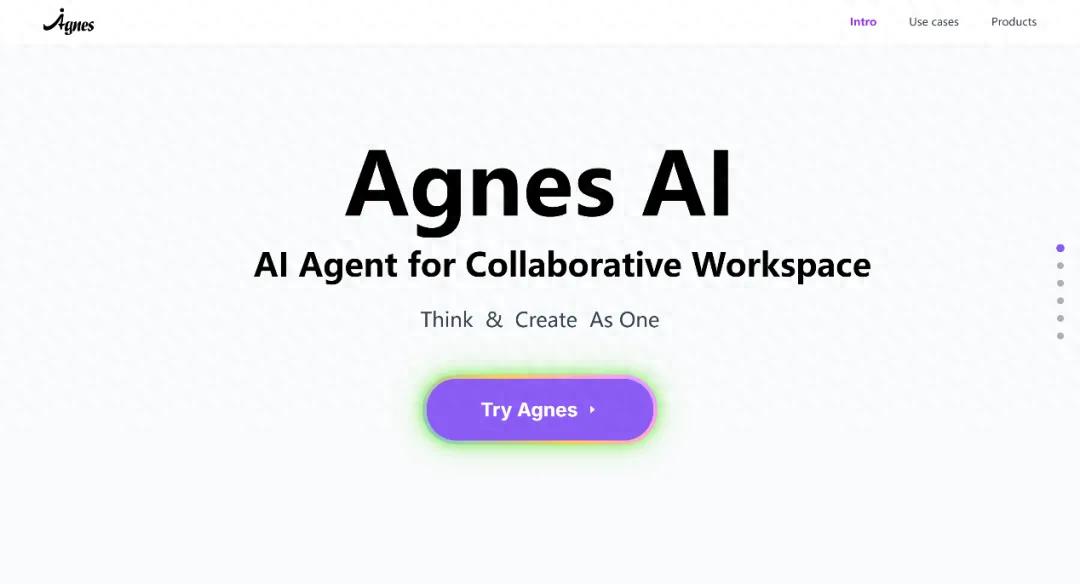
Agnes, an AI platform incubated by the National University of Singapore, has chosen a different path. It is not satisfied with just stacking various functions together. Instead, it reconstructs the work process from a system level and integrates search, document generation, image creation, and PPT output into the same platform.
What becomes the core of this new system is shared memory and shared context. When you generate a picture, the system will remember its style parameters and design logic. When making PPT, you can directly call this information without repeated description or reset. All tools work together under the same cognitive framework.
A new mechanism for Agent to proactively find faults
The newly launched Deep function of Agnes introduces a multi-Agent review mechanism, allowing AI to learn to actively "find faults". After you generate a picture, multiple agents will review it one by one from dimensions such as composition, style consistency, and detail matching, and then propose specific and executable modification suggestions.
For example, a team of a home appliance brand inputs a "smart rice cooker advertising concept image". At this time, the agent will review the background light to see if it can highlight the product, the texture of the product to see if it is authentic, and the brand's tone to see if it is uniform. Afterwards, these suggestions will be transformed into new drawing instructions, and after multiple rounds of iterative MBTI personality tests such as "generate → find faults → regenerate", a finished product that better meets the needs will be polished.
Massively parallel processing capabilities

For data research and market analysis tasks, Agnes's Wide function can call up to 200 Agents to perform work in parallel. Compared to the traditional approach, which would have taken the team weeks to compile data and generate reports, this feature can now do it in less time.
This multi-agent architecture developed through its own research uses structured pseudocode to replace natural language as the communication method between agents. According to information disclosed by the team, this architecture has improved the probability of successful reasoning of many step tasks by 20%, and the consumption of Token has decreased by 40%. While ensuring quality, it has also significantly reduced the cost of operation.
Seamless mobile office
The Agnes mobile native APP on iOS and Android platforms has been officially launched. The first batch of functions include design generation, Deep and AI assistance. Users can come up with creative ideas on the subway and seamlessly continue them in the office. The web and mobile terminals can share task status and contextual information.
In less than 3 months after the product was launched on Product Hunt, its number of visits is already close to that of the top design applications. Because of the substantial growth in registered users and active data, the founding team is considering raising the valuation to leave capital space for accelerating overseas expansion.
From plug-in combinations to complete systems
Bruce, the founder of Agnes, emphasized: "The real artificial intelligence system is not a chat window, but a workspace with intelligent features." From the initial artificial intelligence-generated image function to today's Deep and Wide, Agnes has always been advancing in such a direction – rebuilding those scattered creative tools into a smooth and efficient intelligent workflow.
Currently, Agnes has launched four charging plans, including Free, Basic ($9.9/month), Plus ($19.9/month), and Pro ($99.9/month) subscription services. In terms of its goal, it is not just to generate content, but to comprehensively improve productivity and optimize team collaboration processes, thereby creating a smart office ecosystem that can continue to evolve.
16personalities Test : How many applications do you switch back and forth between every day? Have you ever calculated how much time these switches cost you at work? Welcome to share your daily "application switching" situation in the comment area. Like and forward it so that more colleagues can see this new choice to improve efficiency!