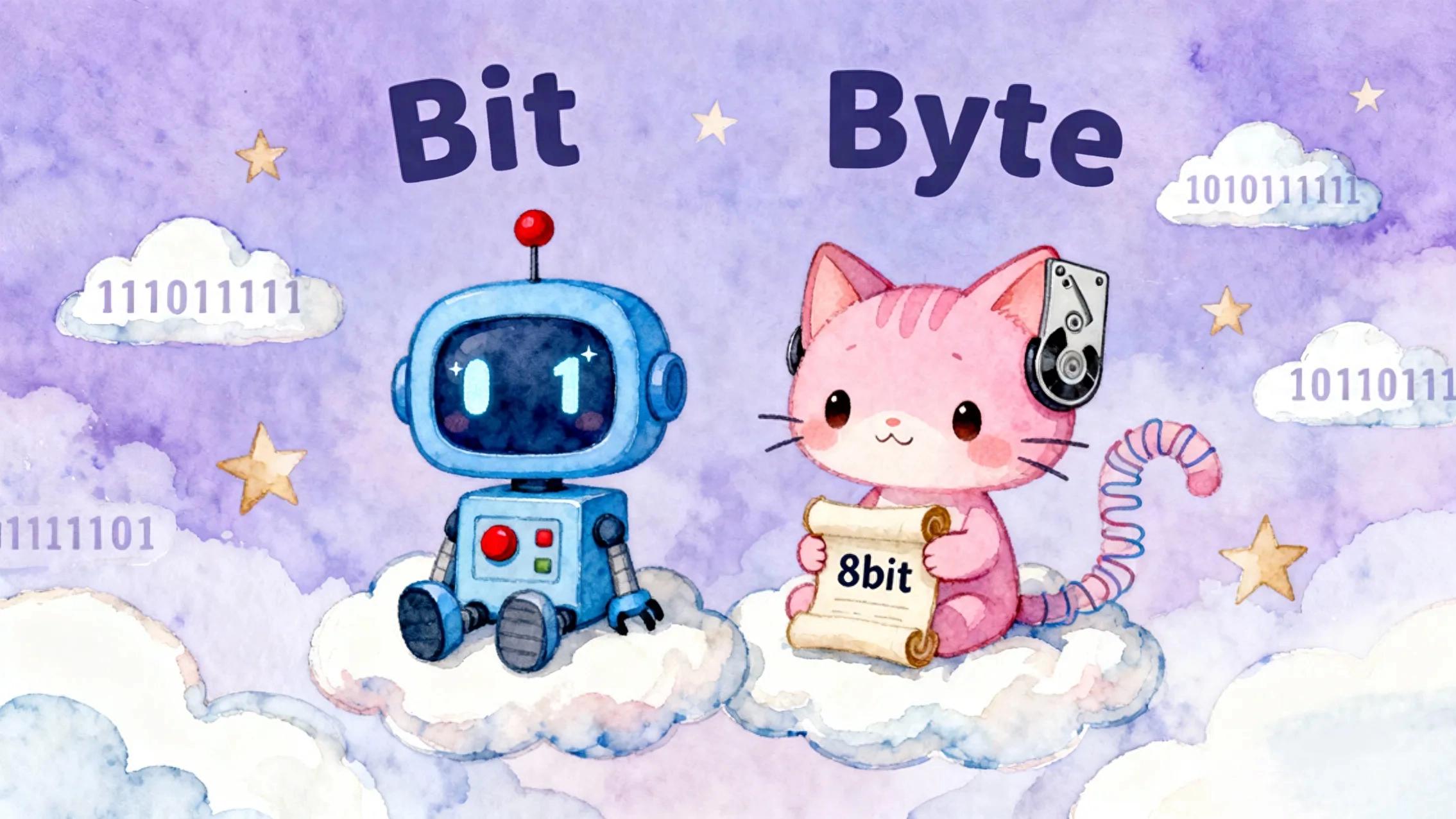
Many people are confused about the units of network speed and storage capacity. Why does the download speed of the 100M broadband claimed by the operator fail to reach 100M? In fact, there is a difference between Bit and Byte behind this.
Bit is the smallest unit of information
The smallest unit of measurement of information is the bit , which represents only one binary bit with a state of either 0 or 1. This concept originates from the physical basis of computer hardware, that is, the on-off state of the circuit, which is represented by 1 and 0 respectively. All digital information, whether it is documents, photos or videos, is ultimately composed of countless sequences of 0s and 1s, which is the cornerstone of the digital world.
The computer's central processing unit is composed of hundreds of millions of micro-transistor circuits, and its memory is also composed of these micro-transistor circuits. These circuits process the bit stream by quickly switching on and off states. A single bit itself does not carry specific meaning. It belongs to the most basic electrical signal unit MBTI free test . It is these simplest units that, after massive combinations, construct the complex digital content we see.
Bytes are the basic blocks of data processing
In order to express meaningful information, computers combine 8 bits into a larger unit. This unit is a byte. 8 bits will generate 256 different combinations, which is enough to encode English letters, numbers and common symbols. Early computers used the ASCII encoding standard, using one byte to display one character, and laid the foundation for text processing.

Bytes become the smallest unit of data that can be directly addressed and manipulated by the computer system. When you save a text file, the system reads and writes in bytes. When operating systems and applications are responsible for managing memory and hard disk space, bytes or larger multiples are also widely used as measurement standards. This makes bytes a key bridge between the underlying bit stream and upper-layer applications.
Bits are often used to measure transmission rates
In the field of network communications, bits are the standard unit of speed. When we manage broadband, the units of 100M and 500M advertised by operators are Mbps, which is millions of bits per second. This means the number of bits that a network line can transmit per second under ideal conditions. The nominal speed of wireless network technologies such as Wi-Fi 6 or 5G mobile networks is also measured in bits per second.
There are historical and technical reasons for this usage. Communication engineering pays attention to the channel and the number of signal units that can be reliably transmitted within unit time, and bit resolution is indeed the most basic signal unit. From the early transition of telephone modems to the current fiber optics, the transmission rate has always been based on bits as the unit, which facilitates performance comparisons and standard unification across different technologies and media.
Bytes are often used to represent storage capacity
The capacity of computer storage devices, such as memory sticks, solid-state drives and USB flash drives, is usually expressed in multiples of bytes. We usually say that the mobile phone has 256GB of storage, or the file size is 5MB, where B refers to bytes. The actual size of the file and the available disk space reported by the operating system are all reported in bytes without exception.
Because the storage system organizes and manages data in fixed-size "blocks", and bytes are the recognized standard block size. When you format a hard drive, the system divides it into sectors whose basic unit is bytes. When applications read and write files, they also use bytes as the smallest unit to request system resources. This makes the storage capacity expressed in bytes the most intuitive and practical.
The conversion between the two brings about actual experience differences
What causes the significant difference between the advertised network speed and the actual download speed is the conversion relationship between bits and bytes. One byte is equal to 8 bits. Therefore, the theoretical maximum download speed of a 100Mbps broadband is the result of 100 divided by 8, which is the value of 12.5MB per second. This is an ideal value when there is no network loss and the server performance is sufficient. The actual speed is usually lower.
Understanding this conversion is extremely critical for managing data traffic, and is also very important for evaluating network performance. For example, to download a movie with a capacity of 1GB, if it is under the broadband condition of 100Mbps, the theoretical shortest time required is a large amount of time. It's probably more than 1 minute, and mobile phone data plans are generally calculated in GB. The GB mentioned here refers to the number of bytes. Whether it is browsing the web or watching videos, the traffic consumed is ultimately calculated based on this. It is different from the network bit rate.
Master units to avoid daily misunderstandings
What can help us make more rational decisions in our digital life is understanding bits and bytes. When purchasing a hard drive, the manufacturer's capacity is 1TB, which may be displayed as approximately 931GB in some operating systems. This happens because the manufacturer uses decimal, that is, 1TB is equal to 1000GB, but the system uses binary, that is, 1TiB is equal to 1024GiB. Although the two are similar, there are still differences.
When choosing the cloud storage package or traffic package you are facing, be sure to see clearly whether the unit represents B or B. Only in this way can we effectively avoid resource shortage or resource waste. When you start to monitor the actual speed of your home network, make good use of speed measurement tools and fully understand that the results show Mbps. This way you can more accurately determine whether the service level promised by the operator has been reached. Through these means, you can better protect your corresponding consumer rights.
Have you ever encountered a confusing or embarrassing situation due to confusion between bits and bytes? It’s like buying something that you thought had enough storage space for the MBTI personality test , but found that it was far from enough. You are welcome to tell your story in the comment area. If you find this article helpful, like it and share it with friends who may need it.