For video editing, the sense of space provided by sound often plays a decisive role in the level of immersion in the work. The Space Designer function in Final Cut Pro is very powerful, but many people are confused about its "global control". Once you understand these parameters, your audio post-production level will be directly improved to a higher level.
Input and pre-delay lay the foundation
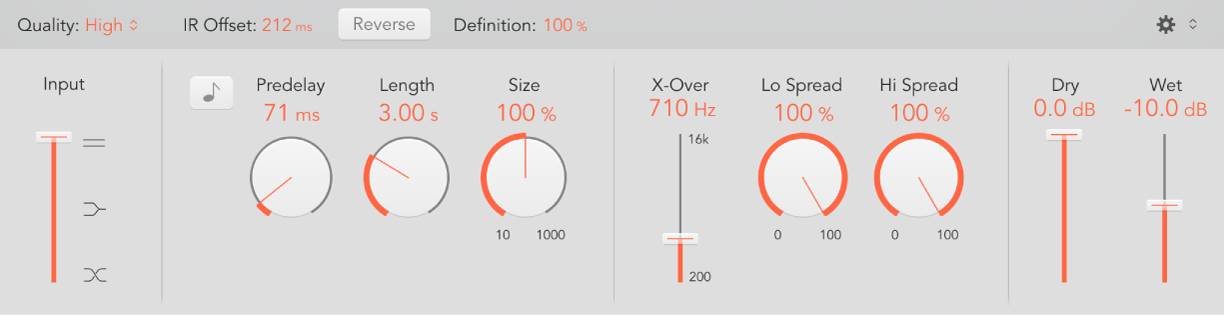
The first thing global control touches is the input signal processing method, in Space. The "Input" slider here determines how the effector receives and processes stereo audio material. Choosing different modes will directly affect the coloration and density of the reverberation.
Once you have your inputs set up, it's time to start thinking about the Pre-Delay knob. What it controls is the time interval between the original sound and the first reflected sound, usually in milliseconds. A shorter pre-delay can make the space appear more compact, thereby simulating the effect of a small room; while a longer pre-delay can create a large space atmosphere with spacious and far-reaching qualities.
The synergy of length and size

The "Length" knob can directly adjust the overall duration of the impulse response. Simply put, the larger the value, the longer the reverberation tail is, and the sound will sound longer and continuous. This parameter plays a key role in shaping whether the space is narrow or wide.
The "size" knob used for adjustment works by changing the sampling speed of the impulse response. After turning it up, the space will sound wider and more open, as if the room has been stretched. It should be noted that "size" and "length" have a close multiplication relationship. When the two are adjusted at the same time, they must be coordinated carefully to achieve the expected decay time.
Reflective shapes shape spatial dimensions
It can change the path and shape of sound reflection around the listener, causing the space to change from a standard rectangle to a more irregular "reflection shape". 16personalities Chinese is a key tool for arranging the spatial distribution of early reflection sound, and plays such a role in surround sound projects.
You can adjust the parameters here to make the sound sound like it's coming from an amphitheater or a long corridor. This directly affects the audience's perception of the outline of the space and is a key step in constructing the details of the real environment.
Functional differences in different modes
Note that not all controls are visible at all times. There are some advanced controls, such as certain input processing options, that only appear after changing the mode to "Sample IR" or "Synthetic IR". If you find that you can't find a certain knob, you can check the current working mode first.
At the same time, there are some controls that are unique to stereo or surround projects. If your project is a monophonic track, some parameters involved in multi-channel space shaping may be automatically hidden. Knowing these limitations can prevent you from falling into the wrong mode and wasting time looking for features that don't exist.
Outputs the ultimate balance of wet and dry sounds
After processing the spatial form, the final step is to adjust the output ratio. The "Dry Sound" and "Wet Sound" sliders each control the levels of the original signal and the signal after reverberation processing. This is the key to determining whether the effect embellishes the original sound or drowns it out.
In actual mixing, generally speaking, the wet sound will not be turned up too loud. An appropriate and reasonable dry-wet ratio can ensure that the sound not only retains its original clarity, but also is given an appropriate ambient atmosphere. For narration, the wet sound should be less; for music or sound effects, it can be increased appropriately.
Practical application of global control
When editing a documentary, you can use the combination of "size" and "length" to create a consistent sense of space for interview audio from different eras. 16personalities test . For example, data clips from the last century can be appropriately reduced in length and size to simulate the listening experience of old-fashioned recording equipment.
When processing the sound effects of movie trailers, you can greatly adjust the "reflection shape" and "pre-delay" to create a dramatic spatial mutation effect. For an originally normal footsteps, after adjusting the parameters, it can instantly transform into the reverberating sound in a large cave, which is extremely impactful.
During editing, what type of audio parameters are most difficult to adjust and make you listen again and again? You are welcome to leave a message in the comment area and share your relevant experience. If you find this valuable content useful, don’t forget to like it and forward it to more friends in need.